Can Spray and Injection Polyurethane Foams Be Used in Cold Seasons?

Can Spray and Injection Polyurethane Foams Be Used in Cold Seasons?
Today, polyurethane foams are widely used in various industries due to their advantages such as low weight, suitable mechanical properties, and adjustable formulations. These applications include building insulation, pipe insulation in the oil and gas industry, building services, cold storage facilities, transportation, and many other industrial fields. With the expansion of polyurethane foam applications, their operating conditions have become more complex than in the past, making their use in environments with varying temperatures—especially hot and cold conditions—inevitable.
Since the formation process and final performance of polyurethane foams are strongly influenced by environmental factors, particularly ambient temperature, evaluating the effect of temperature on foam behavior and properties is of great importance. In this article, Baspar Tose’e Davam Shimi Co. examines the performance of polyurethane foams under both hot and cold temperature conditions and evaluates their behavior from an industrial application perspective.
Effect of Ambient Temperature on Polyurethane Foam
Several factors influence the formation of polyurethane foam (foaming, gelation, and curing), among which temperature—especially ambient temperature—is one of the most critical. Ambient temperature plays a significant role in the formation of homogeneous and non-homogeneous foam cell structures. As the ambient temperature decreases, polyurethane foam becomes denser and its final rise height is reduced; conversely, with increasing ambient temperature, the foam expands more completely and the cell size increases.
As ambient temperature rises, the temperature of raw materials and molds also increases proportionally. This temperature increase enhances the reactivity of polymer molecules and intensifies molecular collisions. Moreover, at higher temperatures, heat loss during the reaction is reduced, leading to a relatively higher system temperature throughout the reaction. These conditions increase both the polymerization reaction rate and the foaming speed, resulting in polyurethane foam with higher porosity or larger microcellular structures.
What Is the Suitable Temperature for Spray and Injection Polyurethane Foam Application?
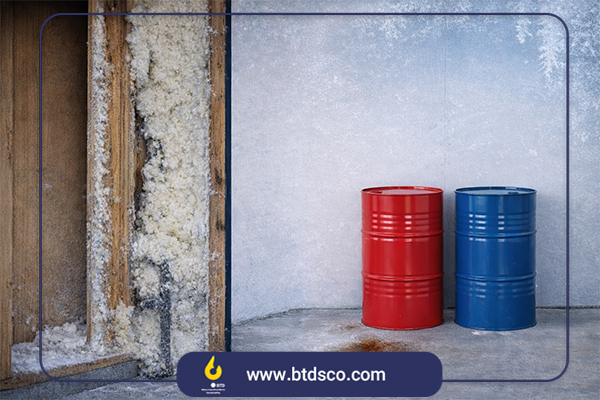
The suitable temperature for applying polyurethane foam—whether by spray or injection methods—under ideal conditions is generally between 20 and 30 °C. However, foam application is also possible within an acceptable temperature range of 15 to 35 °C.
In addition to ambient temperature, the surface onto which the foam is applied must not be frozen, cold, damp, or wet, as such conditions can significantly reduce adhesion and negatively affect the final foam quality. If the ambient temperature is excessively low, the foam gelation process may be delayed, which can result in sagging or foam collapse after application.
Can Polyurethane Foam (Spray or Injection) Be Applied in Cold Weather?
Yes, the application of polyurethane foam by spray or injection methods in cold weather is possible, provided that a set of technical considerations is observed. However, if spray foam is applied outside the temperature range recommended by the manufacturer, the following issues may occur:
- Foam brittleness: At very low temperatures, the foam may become brittle, leading to cracks, gaps in insulation, and reduced thermal and energy efficiency.
- Irregular expansion or contraction: Low temperatures can cause non-uniform expansion or shrinkage during the curing process.
- Incomplete curing: Cold conditions may slow down the chemical reaction between foam components, preventing full curing.
- Reduced adhesion: Applying foam on cold surfaces may result in poor adhesion, foam delamination, and reduced sealing and air-tightness performance.
For spray and injection polyurethane foam application, it is essential that the materials reach the appropriate temperature prior to use. Under standard conditions, the ideal temperature for both materials and application environment is 20 to 25 °C. Therefore, foam application at low temperatures is feasible only if the materials and substrate are properly prepared.
The technical datasheets provided by Baspar Tose’e Davam Shimi Co. are developed based on these temperature ranges, and adherence to them is essential to achieve optimal foam performance.
Storage Conditions of Polyurethane Foam Materials
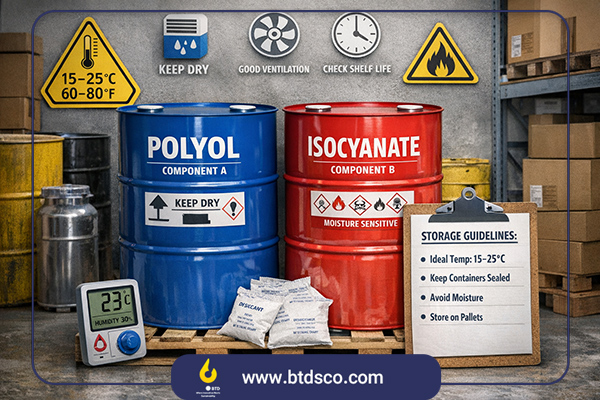
The optimal storage temperature for drums containing polyol and isocyanate is typically within room temperature, approximately 20 to 25 °C. Deviations from this range—either toward higher or lower temperatures—can negatively affect material viscosity, reaction kinetics, and the final performance of polyurethane foam.
Before use, raw materials must be conditioned to the temperature specified in the product datasheet to ensure proper mixing, uniform reaction, and consistent foam quality.
Baspar Tose’e Davam Shimi Co. is a supplier of various spray and injection polyurethane foam systems. for more information please contact us.



News